



I. Product Introduction
Titanium slabs serve as raw material for rolling titanium plates. Typically produced by forging and rolling square ingots after smelting sponge titanium, the quality of slab forging directly impacts the performance of finished titanium plates. Improper temperature control may cause slab fracture and surface flatness issues.
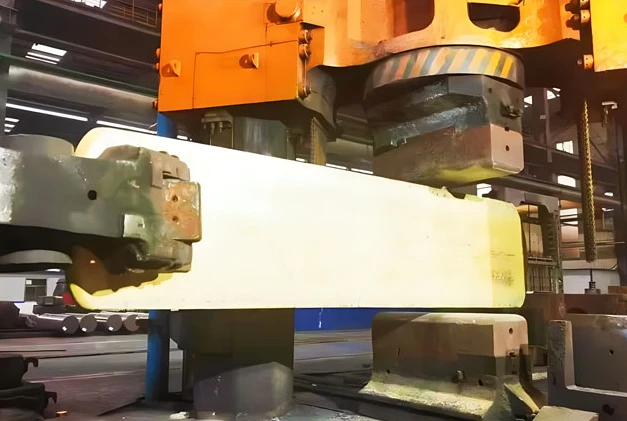
II. Forging Process
1. Preheating Treatment
Preheating is a critical step in the forging process of titanium alloy forgings. Its purpose is to eliminate internal stresses in the titanium alloy, reduce deformation resistance, and enhance plasticity. Commonly used heat treatment processes include: vacuum heat treatment, gas-shielded heat treatment, and plasma heat treatment.
2. Forging
The forging processes for titanium slab blanks primarily include open die forging, die forging, and ring rolling.
(1) Free Forging
Free forging involves the unrestricted deformation of metal material during the forging process. However, its drawbacks include lower precision in forgings and difficulty in producing complex structural components.
(2) Die Forging
Die forging involves metal deformation within the confines of a die during the forging process. Its characteristics include high precision in forgings and the ability to produce complex structures. However, die forging has the drawbacks of higher production costs and stringent requirements for dies.
(3) Ring Rolling
Ring rolling involves shaping metal materials into ring-shaped forgings through rolling pressure during the forging process. Its advantages include high production efficiency and relatively high precision of forgings. However, the disadvantage is the difficulty in producing large-diameter, thick-walled forgings.
Hot Tags: titanium slab, China titanium slab manufacturers, suppliers, factory, rutile tio2, , raw titanium, nano titanium dioxide


