

3D printing is a form of rapid prototyping technology, also known as Additive Manufacturing (AM) . It builds three-dimensional objects by accumulating materials layer by layer under digital control. This technology offers significant advantages in the rapid fabrication of complex structures, precise control over microstructures, and high material utilization efficiency. As a result, 3D printing is finding increasingly widespread applications in consumer electronics, aerospace, industry, and various consumer-oriented scenarios.
3D Printing Process
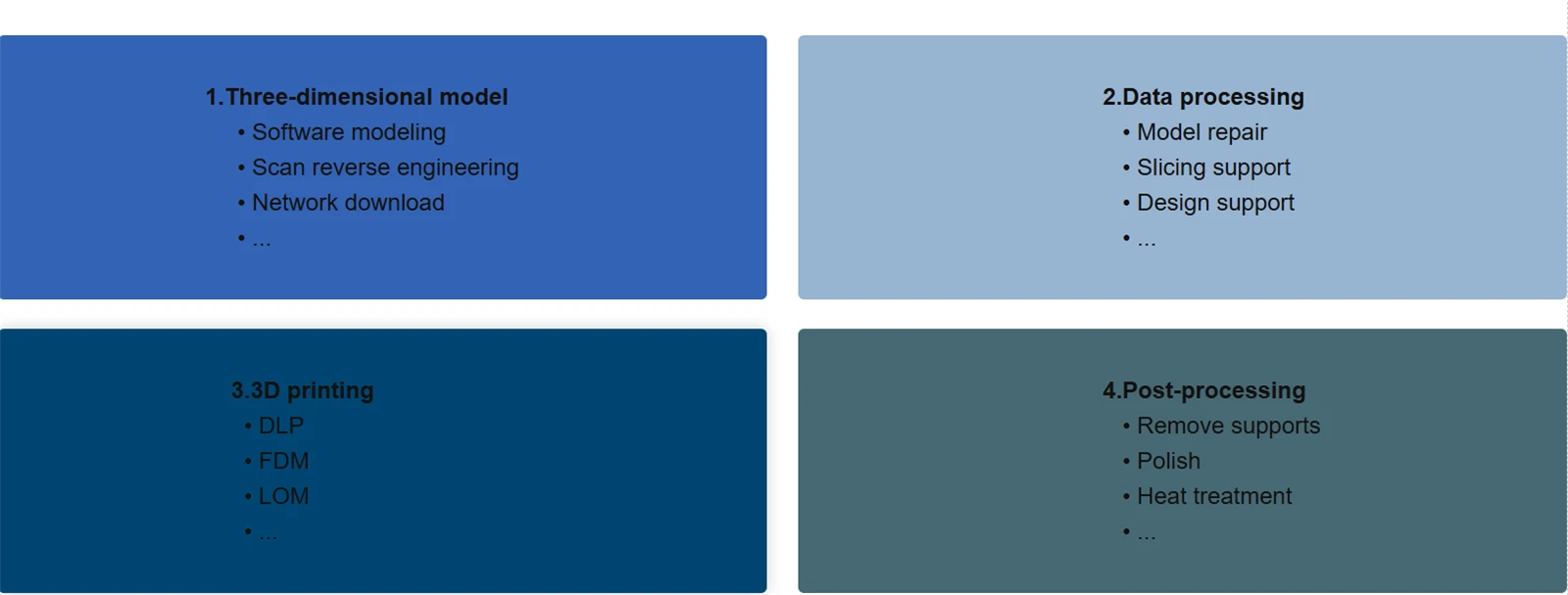
Although there is currently a certain gap between metal 3D printing technology and traditional precision machining techniques in terms of processable materials and machining accuracy, its innovative manufacturing approach offers unique advantages that traditional precision machining cannot match:
Shortening the New Product R&D and Realization Cycle: The 3D printing process is driven directly by three-dimensional models, eliminating the need for auxiliary tools like molds and fixtures. This can significantly reduce product development cycles, save on expensive mold production costs, and accelerate the iteration speed of product design.
Efficiently Forming Complex Structures: 3D printing deconstructs complex three-dimensional geometries into two-dimensional cross-sections for layer-by-layer fabrication. This enables the forming of intricate components that are difficult to achieve with traditional precision machining, improving product yield rates and quality.
Enabling Integrated and Lightweight Design: Metal 3D printing technology can optimize the structure of complex parts by redesigning them into simpler forms, thereby reducing weight. It also allows for the integrated forming of components, which enhances product reliability.
High Material Utilization: Compared to traditional precision machining, metal 3D printing technology can save a significant amount of material, leading to cost reductions.
Achieving Excellent Mechanical Properties: Due to the rapid solidification characteristic of the 3D printing process, the internal metallurgical quality of the formed parts is uniform and dense, free from other metallurgical defects. Furthermore, this rapid solidification results in a fine, sub-structural internal material organization, allowing the formed parts to achieve significantly improved strength without sacrificing plasticity.