
The core logic of waterjet cutting titanium plate is "cold instead of hot": using a high-speed water-abrasive jet to erode the material rather than melt it, thereby avoiding the pain points of titanium easily absorbing hydrogen and oxidizing at high temperatures. For thick plates and parts sensitive to thermal damage, it is a reliable choice for safeguarding material properties.
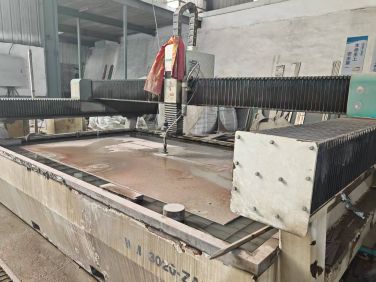

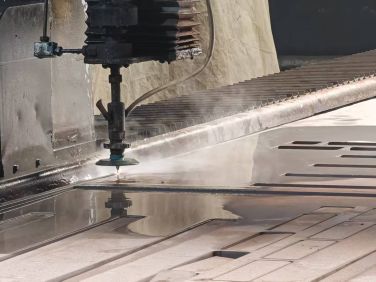

Equipment Configuration and Application Scenarios
Our company is equipped with two waterjet cutting machines, providing stable titanium plate processing capability. When customers do not specify a cutting method, the process typically assigns titanium plates above 14mm and profiled (irregular-shaped) parts to waterjet cutting. If laser cutting is used for thick plates, the sparks generated will affect the titanium plate surface and increase its hardness; for profiled parts, the high contour adaptability required makes waterjet's flexible path advantage obvious.
Precision Control and Allowance Design
The contour accuracy of our waterjet-cut titanium plates is controlled to approximately 1mm on both sides (double-sided 1mm), which meets the dimensional requirements of most blanks or non-mating surfaces. However, waterjet is an abrasive cold-cutting process - the jet loses energy through the plate thickness, so the cut edge of the titanium plate develops a certain slope (taper), wider at the top and narrower at the bottom. The greater the thickness, the more pronounced the taper. For this reason, the process requires a 1.5mm allowance per side: the cutting path is offset outward to leave removal stock for subsequent CNC finishing or mating surfaces, ensuring final dimensions are within tolerance.
Process Summary
The practical significance of this arrangement lies in: using waterjet to solve the problems of "can it be cut, will the material be damaged, can it follow irregular shapes," while the reserved allowance compensates for the "tapered edge" precision limitation. For titanium plate blanks above 14mm and profiled contour forming, waterjet is a pragmatic choice that balances material protection with contour flexibility; critical mating surfaces are then finished by machining after the 1.5mm allowance is left to ensure final precision. When the customer does not specify a cutting method, this process route can serve as the default solution for thick plates and profiled parts.