

Titanium alloys have made remarkable strides in aerospace, medical devices, and high-end consumer electronics due to their high strength, low density, and outstanding biocompatibility. The key to their functionality and aesthetic appeal lies in the ultra-precision mirror polishing process.
I. Optical-Grade Precision, Redefining Surface Limits
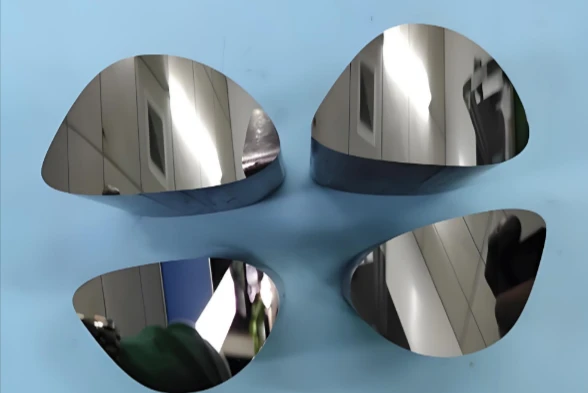
The core objective of titanium alloy mirror polishing is to achieve an "ultra-smooth, highly reflective, low-defect" surface. Through multi-stage polishing (rough grinding → semi-fine polishing → fine polishing), combined with elastic polishing wheels and nano-diamond grinding slurry, surface roughness can be controlled to Ra ≤ 0.01μm, meeting the 12K mirror standard. At this stage, the microscopic peak-to-valley difference is less than 100nm, approaching the level of a single molecular layer.
II. Major Performance Upgrade, Comprehensive Functional Enhancement
Mirror polishing isn't just about aesthetics-it's key to enhancing titanium alloy performance.
• Corrosion Resistance Skyrockets: Post-polishing nitric acid passivation forms a dense TiO₂ oxide layer on the titanium surface. Salt spray tests demonstrate a 3-5x increase in corrosion resistance for treated samples, meeting the 96-hour corrosion-free requirement of ISO 9227 and significantly extending the lifespan of marine equipment.
• Biocompatibility Revolution: Medical-grade polishing reduces surface energy (contact angle <10°), lowering bacterial adhesion by 70%. Field tests show a 82% reduction in Staphylococcus aureus biofilm formation on polished titanium implants, offering safer options for orthopedic and dental implants.
III. Stunning Aesthetics, Setting New Standards in Industrial Design
The high-reflectivity mirror finish imparts exceptional aesthetic value to titanium alloy products. With a reflection clarity of up to 95%, it accurately reproduces facial features and textual details, perfectly meeting the demands of luxury goods, automotive trim components, and other high-end applications.
IV. Stable Mass Production: Transitioning from Laboratory to Industry
This technology has successfully transitioned from laboratory development to mass production.
Batch consistency is guaranteed: Six Sigma process management ensures surface roughness fluctuations remain within ±5%. Leveraging closed-loop polishing pressure control (±0.1N precision) and a constant grinding fluid flow system (±0.5ml/min), consistent quality is effortlessly achieved across production runs of tens of thousands of units.
V. Extensive Application Scenarios, Empowering Multiple Industries
• Aerospace: Engine blade polishing reduces airflow separation losses by 15%, significantly improving fuel efficiency.
• Medical Devices: Reduced surface roughness of joint implants accelerates osseointegration by 40%.
• Consumer Electronics: Mirror-finishing of smartphone midframes achieves 98% light reflectivity, greatly enhancing brand recognition.